
“I will make your descendants as numerous as the stars in the sky” (Genesis 26:4 NIV)
“This is how we know what love is: Jesus Christ laid down his life for us.”
1 John 3:16
There is an old children’s story called ‘The Giving Tree’ written by Shel Silverstein over half a century ago. The story basically follows the story of an apple tree and a boy who become friends and from childhood to old age how the tree provides in various ways for the boy. As a child the tree provides shade, a place to climb and fruit to eat and enjoys the boy’s company in return. However, as time passes, the boy grows up and spends less and less time in the tree’s company and only visits when he needs something from her. The tree is happy to give her branches to help him build a house and fruit from her branches for him to sell to make money. Once the boy is an old man, the tree is just a stump but even then, what remains of the tree provides a place for the boy, now old and tired, to sit for rest and quiet reflection. The tree in the story gives everything for love of the boy, though that love is not always reciprocated. Though the boy’s taking attitude is not exemplary, the tree in the story does present a beautiful picture of unconditional love.
This imperfect picture, points to the perfect image of sacrificial unconditional love that we witness in Jesus as “Emmanuel”, God with us, crushed as the scripture says for our wrong doings, brokenness and shame and restoring us from the place of shame that we felt consumed by or lost in to one of high honour, intimacy and peace with God.
There is a moment in the Easter story that follows Jesus to the cross that sometimes gets overlooked but which highlights the very power and torrent of Christ’s unconditional and sacrificial love for the sinner he so desired to save and set free.
“Now it was the custom at the festival to release a prisoner whom the people requested. A man called Barabbas was in prison with the insurrectionists who had committed murder in the uprising. The crowd came up and asked Pilate to do for them what he usually did. “Do you want me to release to you the king of the Jews?” asked Pilate knowing it was out of self-interest that the chief priests had handed Jesus over to him. But the chief priests stirred up the crowd to have Pilate release Barabbas instead. “What shall I do, then, with the one you call the king of the Jews?” Pilate asked them. “Crucify him!” they shouted. “Why? What crime has he committed?” asked Pilate. But they shouted all the louder, “Crucify him!” Wanting to satisfy the crowd, Pilate released Barabbas to them. He had Jesus flogged, and handed him over to be crucified.”
Mark 15:6-15 (NIV)
Jesus remained silent as Barabbas, a known murderer, and a chief instigator of rebellion against Roman rule in Judea, was unchained, released from prison, and freed from certain punishment. Barabbas was given his undeserved freedom but Jesus, his stainless innocence undented and upheld by the whole hosts of Heaven, stood silently as he was given over to be flogged and condemned to a cruel death.
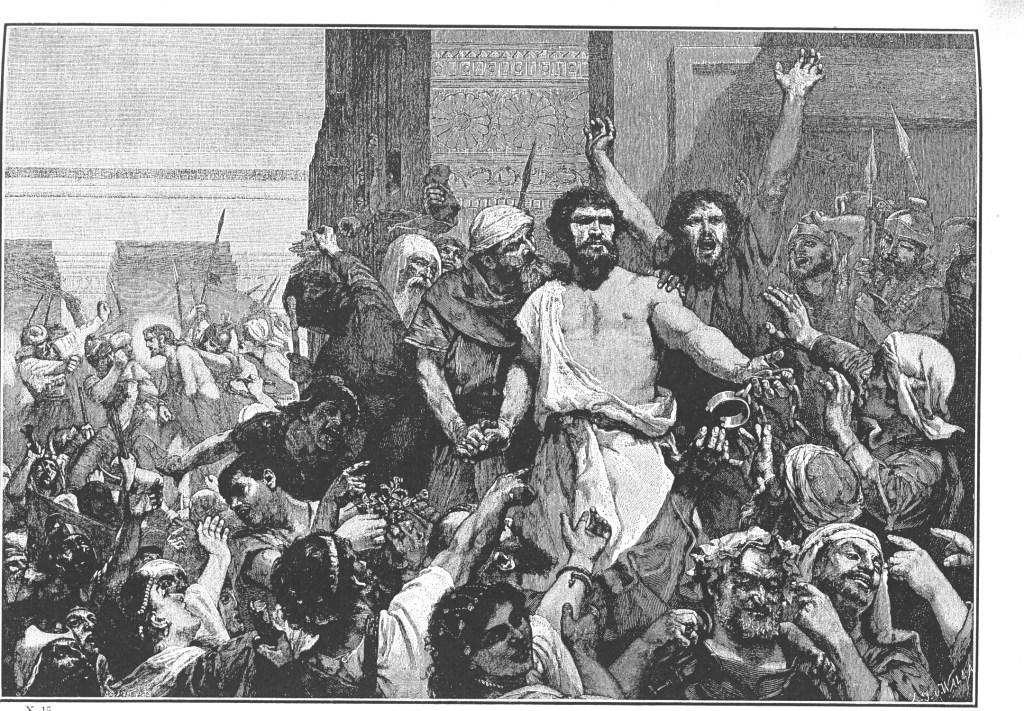
Illustration from volume 9 of The Bible and its Story Taught by One Thousand Picture Lessons, eds. by Charles F. Horne and Julius A. Bewer, (1910).
(Wikicommons)
The Bible does not mention whether Barabbas ever realised what his freedom would symbolise for humanity and what it cost the one who stood innocently looking on as Barabbas was unshackled only to take his place to be condemned to death. That is our saviour and Lord, Jesus.
He was oppressed and afflicted, yet he did not open his mouth;
Isaiah 53:7 (NIV)
he was led like a lamb to the slaughter, and as a sheep before its shearers is silent, so he did not open his mouth.
We will never know for sure this side of heaven whether Barabbas’ heart ever melted to the revelation of what Christ did for him that day and responded in repentance. Did he discover the joy of what Christ’s finished work at the cross had done for him not only in setting him free from a physical prison and a deserved punishment but also ended his eternal spiritual captivity and separation from a loving, merciful Heavenly Father?

This picture in the Easter story is one of a saviour offering the most supreme overflow of unconditional love to the one who is not deserving of it by giving his very self, though not guilty of any wrongdoing, in the place of the one who is. We may not be violent criminals like Barabbas was, but every one of us spiritually is the Barabbas for whom Jesus, out of a vast well of love running deeper than we could ever fathom, died in our place. His death at the cross and resurrection has secured an eternal freedom for us from prisons of shame; unworthiness; wrongdoing and we, even as our hearts respond in worship and thanksgiving, are being stripped of grave clothes of brokenness, counterfeit identity and sinful beliefs that are not in line with what the author of perfect love says and feels towards us. In place of these we are bearers of white robes of righteousness, our names are engraved on our saviour’s hand and we have entered into an eternal intimate relationship with a God who not only permits but desires us to call him by the familiar term of affection “Abba”, Daddy.

If you need to be reminded of God’s love for you today, look at Barabbas and see what Jesus gave for him to be free and what he has given for you to be free, for he is just as much someone who Jesus loved as you and me. As the meaning of Barabbas reveals, he is a “son of Abba” or child of Abba” the affectionate intimate name for almighty God and so are we! Give thanks for his unfailing love today!
 Abba's Dearly Beloved